+ Real Crusades History +

+ Real Crusades History +
Showing posts with label native Christians. Show all posts

Wednesday, July 25, 2018

Crusader Society Re-Visited: Rural Knights Living in Harmony with the Local Christian Population


For the better part of the 20th century, Frankish society in the Holy Land was depicted as a decadent urban elite, collecting rents from oppressed native farmers. Allegedly, the Franks were afraid to venture into the hostile environment of the countryside, not only because of an “ever-present” Saracen threat but also because they were hated by their own tenants and subjects. Some historians such as Joshua Prawer did not hesitate to draw parallels between Frankish rule in Palestine/Syria and apartheid in South Africa.

Yet such conclusions, no matter how superficially convincing or confidently proclaimed, have been rendered obsolete by the meticulous studies and archaeological surveys conducted by the Hebrew University of Jerusalem. What follows is a short summary of the findings of these studies.  


In his seminal work Frankish Rural Settlement in the Latin Kingdom of Jerusalem (Ellenblum, Ronnie. Cambridge University Press, 1998) Professor Ellenblum has catalogued the findings of meticulous (indeed tedious) study of legal documents recording the demarcation and/or sale and settlement of disputes over landed property combined with an intensive archaeological survey. The “data mining” of the documents enabled the “reconstruction” of entire villages ― property by property ― identifying in the process the origins and vocations of many of the inhabitants. The archaeological survey turned up roughly 200 Frankish settlements in the geographically limited area of the study alone. Most of these had never been heard of before, either because the settlements themselves had since been abandoned, ruined and obliterated by nature, or because their Frankish origins were hidden behind modern Arabic names and more recent construction.

This research revealed that Frankish rural settlement was much more widespread than had been previously assumed ― without evidence. The Franks, the survey proved, built large numbers of smaller towns and villages, often without walls or fortifications of any kind ― a clear indication that they did not feel as threatened as historians hypothesized. The survey further uncovered evidence of Frankish manor houses and farmhouses, of Frankish mills, irrigation, and terracing systems and of roads. The latter, as Ellenblum points out, required not only a major investment in construction but also a permanent investment in maintenance.  Perhaps most significant, the survey turned up hundreds of parish churches, an investment that underlined the fact that these villages were not inhabited by a Muslim peasant population. The villagers and permanent residents of these Frankish settlements were irrefutably Christian since churches need not be built where there are no parishioners. (Note: in other regions mosques proliferated.) 

Copyright M. Foltz
While it cannot be proved that the Frankish lords lived permanently in the rural castles and manors they built, it is hardly credible that they built large, expensive stone manors and castles for the comfort of their “oppressed” native serfs. Furthermore, the documentary evidence revealed that many of these rural manors owed sergeants or knights to the lord.  In short, just as in Europe, these rural estates were held as fiefs by the Frankish elite.  In contrast to the assumptions of earlier historians, the backbone of the Frankish army was composed of rural knights, who drew their income from agriculture not urban “money fiefs.”  The knights of Outremer, far from being the decadent city-dwellers of legend, were countrymen and farmers, just as they were in Western Europe.

Equally significant, the Frankish settlers did not displace the local inhabitants, expelling them from their land and houses.   They did not deprive them of either their land or their status. On the contrary, the documentary evidence proves that the Franks were punctilious in recording and respecting the rights of the Syrian inhabitants. Rather than displacing the locals, they built villages and towns in previously unsettled areas or, more commonly, built beside existing towns.  The most common pattern was to build a castle/manor on the highest point outside an existing town/village and settle Frankish farmers at the foot of this administrative center. The native towns and villages, usually located in valleys, were left intact along with the ownership of the land cultivated by the native inhabitants. What this meant is that the Frankish settlers were bringing new land under cultivation. To do that they built terraces, reservoirs, cisterns and highly sophisticated irrigation systems, sometimes based on dams and mills or employing aqueducts. 


And who were these settlers? Based on nearly complete records for a sampling of settlements it is possible to show that these settlers came from widely separated areas in the West. For example, in the town of Mahomeria 150 Frankish households were identified with heads-of-household originating in Burgundy, Poitiers, Lombardy, the Ile de France, Bourges, Provence, Gascony, Catalonia, the Auvergne, Tournai, Venice and eight other towns no longer clearly identifiable but apparently in France or Italy. The largest number of families coming from any one place was four.

This helps explain why, as Fulcher of Chartres claimed in his History, the settlers rapidly lost their ties to their “old country” and identified with their new residence. (“We who were Occidentals have now become Orientals. He who was a Roman or a Frank has in this land been made into a Galilean or Palestinian.” Fulcher of Chartres, A History of the Expedition to Jerusalem, 1095-1127, Book II.) Ellemblum points out that the 12th century was a period in which many people were emigrating from their place of birth to new areas in search of better opportunities, and that the Holy Land was only one of the options available to these adventurous and ambitious settlers.

Equally important, and a major thesis of Ellenblum’s work, is the fact that the “Franks” (whatever their place of origin) settled almost exclusively near to existing native Christian communities. Even new settlements were in regions where the nearest communities were predominantly Christian. Indeed, the Franks in some cases built castles in response to requests from the native Christian population. For example, the castle of Kerak in Oultrejourdain was built in 1142 because “the Christian inhabitants of the place begged the Franks to build the castle in order to protect them.” (Ellenblum, p. 141.) However, as Ellenblum proves, the Franks avoided settling in regions that were predominantly Muslim.

This was possible because large parts of the Holy Land were still predominantly Christian. For example, Muslim scholar Ibn al-Arabi, who spent several years in Palestine shortly before the First Crusade, wrote that the countryside around Jerusalem (as opposed to the region around Acre) was “still theirs” ― i.e. still Christian! Indeed, areas with the greatest concentration of Frankish settlements in the 12th century still had many towns that were still predominately ― if not exclusively ― Christian in the 1922 census! For example, the 1922 census for the town of Abud recorded 335 Greek Orthodox Christians and 41 Latin Orthodox Christians and not one single Muslim.

What this tells us is that the Islamization of the Holy Land was neither as complete nor as geographically homogeneous as historians previously assumed. If, as has been argued by other historians, people converted to Islam to avoid the extra taxes, humiliations and disadvantages of life as a "dhimmis” (non-Muslims of either Christian or Jewish faith, i.e. “people of the Book,” who had not yet converted to Islam), then Islamization should have occurred evenly across the entire region. Opportunists and men of ambition are not concentrated by location.  Yet, as Ellenblum proves beyond a shadow of a doubt, the Muslim population was concentrated in clearly delineated regions.

 
Ellenblum postulates that the Muslim population of the Holy Land in the 12th century were for the most part not converts but immigrants. Taking the example of Samaria, a predominantly Muslim region during the crusader period, he shows that the region had been largely depopulated before the Arab invasions.  “In the revolt of 529 almost 20,000 Samaritans were killed in one battle and others fled over the Jordan…The last revolt of 556 was followed by massive expropriation of property and a plague that decimated the population.” (Ellenblum, p. 262.) When the Arab invasion came, Samaria was still desolate and largely unpopulated: “…the region was abandoned by its original sedentary population and the subsequent vacuum was apparently filled by nomads who, at a later stage, gradually became sedentarized.” (Ellenblum, p. 264.) In short, by the 12th century, the inhabitants of Samaria were largely Muslim, but not because the Christian/Jewish/Samaritan population had converted, but rather because Muslims from elsewhere had settled there.

The patterns of settlement meticulously documented by the Hebrew University of Jerusalem has other implications for Frankish society.  Because Franks settled almost exclusively in regions that were still predominantly Christian they did not feel like aliens nor did they feel threatened by possible cooperation between their native neighbors and their Muslim enemies. After all, in several well-documented cases “the local Christian population…was overjoyed at the conquest of First Crusade and…welcomed the Frankish conquerors.” (Ellenblum, p.136)  When the Frankish settlers (farmers and craftsmen rather than soldiers) followed the crusaders (men of war) to the Holy Land, they built and shared the churches with the Orthodox natives, just as they shared the markets and intermarried with native Christians. Native Christians, as Christopher MacEvitt (The Crusades and the Christian World of the East: Rough Tolerance. University of Pennsylvania Press, 2008) also documented, were integrated into the Frankish administration. While they did not form the pinnacle of either secular or ecclesiastical society, they held positions of authority, responsibility, and trust. 


In conclusion, the work of the Hebrew University of Jerusalem shows that the crusader Kingdom of Jerusalem was not a fragile construct composed of a tiny and frightened alien, urban elite living separated from (and looking down on) their predominantly Muslim subjects.  The Frankish elites did not hover behind the high walls of cities and isolated castles, in constant fear of their “subjugated” native population and the next Saracen attack.  On the contrary, the Muslims living inside the Kingdom were almost certainly still a minority of the population, living in concentrated pockets where the Franks did not settle, and for long periods, notably from 1120 to 1177, there were no invasions of the core of the Kingdom of Jerusalem. In short, the Frankish population felt completely secure for the better part of the 12th century.

Likewise, although there were urban Latin elites, notably the Italian communes, that were by nature city-dwellers in Italy no less than in Syria, these were not the backbone of Frankish society.  Large numbers, easily more than the previously estimated 140,000 Frankish settlers (estimates that pre-date the archaeological survey of the Hebrew University of Jerusalem), lived in essentially rural communities, making up a substantial portion of the population.  Most of the knights of the Frankish army, like knights in England and France, likewise lived on rural estates and earned their income from agriculture. The Franks shared towns and churches, mills, reservoirs, and wells with the still predominantly Christian native population, and it was this mix of Frankish and native Christians that constituted and characterized the crusader Kingdom of Jerusalem in the 12th century.


Crusader society is depicted as accurately as possible in Dr. Schrader's novels set in Outremer: 


       Buy now!                                       Buy now!                                         Buy now!


Dr. Helena P. Schrader holds a PhD in History.
She is the Chief Editor of the Real Crusades History Blog.
She is an award-winning novelist and author of numerous books both fiction and non-fiction. Her three-part biography of Balian d'Ibelin won a total of 14 literary accolades. Her most recent release is a novel about the founding of the crusader Kingdom of Cyprus. You can find out more at: http://crusaderkingdoms.com


Thursday, March 23, 2017

Liberation or Oppression? Native Christians and the Crusades


It is commonplace for people to portray the crusaders not only as barbarians vis-à-vis their Islamic enemies, but as “oppressors” of the native Christian populations that lived under crusader rule.  These popular views have their roots in books by scholars such as Runciman, Smail and Prawer, all of whom have argued to varying degrees that the crusader elites, like colonists, lived segregated lives for the natives of the Holy Land, and (as Prawer put it) practiced a form of “apartheid.” Yet, other historians have argued quite the opposite, claiming those crusaders who settled in Outremer soon “went native” and became “more oriental than European.” Today Dr. Schrader discussed how recent research and archaeological evidence are revising the picture of crusader-native relations yet again.


Starting with the basics, the “native” population of Outremer that confronted the crusaders on arrival in 1099 was anything but a homogenous mass. First and foremost, it was not ― repeat, not ― predominantly Muslim. Historians are continuing to revise downwards the proportion of the population that had, in fact, converted to Islam during the less than four hundred years of Muslim domination.


Certainly, there were still Jewish communities, concentrated in Jerusalem, Tyre and Tiberius when the crusaders arrived. In sharp contrast to Western Europe that saw significant attacks on Jewish communities in association with the crusades, there was no systematic persecution of the Jews in the crusader states. On the contrary, although Jews were prohibited from living in the city Jerusalem, other cities, particularly Acre and Tyre, hosted large Jewish communities. There were rabbinical courts in both Acre and Tyre, and Palestine in the crusader period was one of only three contemporary centers for Talmudic studies. There is also anecdotal evidence that Jews continued to pursue respected professions such as medicine, and took part in commercial activities. There is no evidence that they were required to wear distinctive clothing or live in segregated communities, although it is almost certain that like the remaining Muslim population they were subject to additional taxes.


In addition, there was still a large Samaritan population. (Note: Samaritans believe that only the first five books of the Hebrew bible were divinely inspired.) Although many Samaritans had been driven into exile across the Middle East, the center of Samaritan worship and scholarship was located in Nablus, and this was where the largest Samaritan population was concentrated in the crusader era. The Samaritans appear to have flourished under crusader rule and a large number of Torah scrolls produced by the Samaritans have survived, suggesting a flourishing of activities rather than the reverse. 


Turning to the Christian population of the crusader states, this was divided theologically into three main groups: Melkites (more commonly but confusingly called Greek Orthodox although many of them did not speak Greek), Jacobites, and Armenians. In addition, there were small pockets of Maronite, Nestorian, Coptic and Ethiopian Christians resident in the Holy Land. The Armenian and Jacobite Christians indisputably made up the vast majority of the population in what was to become the County of Edessa and the Principality of Antioch. In what was to become the County of Tripoli, on the other hand, Maronite Christians were more numerous, but it is no longer clear if they made up an overall majority of the population or not. The Kingdom of Jerusalem appears to have had the most fragmented population with all of the above Christian and Jewish communities present, as well as some Muslims.


The situation is complicated by the fact liturgical and linguistic differences were not conform. While as a rule, Armenian Christians spoke and heard Mass in Armenian, the same cannot be said for Melkite Christians, who might still speak and hear Mass in Greek, but were just as likely to speak and worship in Syriac or Arabic.  Jacobites, Copts and Nestorians appear to have spoken and worshiped predominantly in Syriac and Arabic, but this adds to confusion when dealing with contemporary records since neither the use of Arabic in documents nor Arab-sounding names necessarily denoted Muslims ― a factor that has undoubtedly contributed to earlier exaggerations of the size of the Muslim population under crusader rule.


All these forms of “Orthodox” Christians were viewed with various degrees of skepticism by the Roman Catholic hierarchy. Theologians were very concerned about the ― to layman’s eyes ― microscopic differences in doctrinal interpretation. Some of these Christian sects were considered “heretics,” but most were viewed merely as “schematics” ― by the Church. That said, the crusader states were not theocracies run by religious scholars, but secular states run by educated but fundamentally hard-nosed, practical, fighting men.


The feudal elites of the crusader states might have been pious enough to take the cross, but that did not make them masters of theological finepoints. They had answered the Pope’s call to “liberate” the native Christians from Muslim oppression, and the evidence is quite overwhelming that they did exactly that. Nor did they suddenly start oppressing those Christians themselves. On the contrary, all local Christians, regardless of liturgical rite, were immediately freed of the taxes, humiliations, and indignities imposed on them by Muslim rule.


The rule the crusaders “imposed” on the liberated territories, furthermore, borrowed far more from the traditions of the Eastern Roman Empire (Byzantium) than Western Europe. Recent scholarship demonstrates that, contrary to earlier assumptions, the crusader states did not introduce any form of serfdom on the native peasants ― Christian or Muslim.  On the contrary, although agricultural workers were effectively “tied” to the land, they did not owe any of the other feudal dues. Thus they were not required to work the lord’s land, did not have to pay to marry, retained ownership of their homes and moveable goods, and paid sometimes as little as one quarter of the corps to their lord.


Furthermore, for members of the native elites, the situation under crusader rule was full of opportunities for advancement and enrichment. The new rulers needed the support of local elites in order to govern. The native elites had opportunities in a wide range of fields from collecting taxes and administering rural communities as “scribes” and “ra’is,” to serving as tax-collectors, harbor-masters, and accountants in the cities. Christopher MacEvitt in his excellent work The Crusades and the Christian World of the East: Rough Tolerance has provided examples of native Christians being land-owners in their own right, and being wealthy enough to make charitable bequests of significant value.  In addition, he claims to have identified native Christians serving as knights and, in one case, even as Marshal of Jerusalem. While earlier historians have assumed that these native Christians “must have” first converted to Latin Christianity, MacEvitt argues that there is no evidence of this whatsoever.


On the contrary, MacEvitt notes that there is ample evidence of the Frankish and native Christian communities intermingling not just in the bazaars and taverns, but by undertaking the same pilgrimages, by sharing churches, by taking part in the same processions, and by using each other’s priests as confessors ― a clear indication that for the average Frank the common belief in Christ outweighed the theological differences that animated church scholars. Riley-Smith notes that native Christian clergy enjoyed the privilege of being exempt from the jurisdiction of secular courts just as much as Latin clergy did. MacEvitt notes that the reason almost all Greek Orthodox patriarchs were replaced by Latin patriarchs is that they had already fled the Holy Land in the face of Muslim persecution before the arrival of the crusades. He notes further that on their arrival in Antioch “the crusaders enthroned the Greek patriarch...recognizing his authority over Latins and Melkites alike." (MacEvitt, p. 111.) Adding, “more Melkite bishops could be found throughout Palestine after the crusader conquest than had been there in the previous fifty years.” (MacEvitt, p. 112). The only instance of a Melkite bishop being ousted had to do with power politics (an attempt by the Greek Emperor to impose his authority) not church politics.


When we remember that “turcopoles,” native horseman, made up a significant portion of the feudal army of Jerusalem, we see further evidence of the fact that native Christians were far from oppressed. The fact that they were financially in a position to provide mounted troops underlines the fact that they were affluent and empowered. (Muslim laws prohibited Christians from riding and owning horses.) Perhaps more important, the fact that that native Christian communities consistently provided large numbers of these mounted troops to both offensive and defensive armies led by Frankish kings and barons shows that native Christians did far more than just intermingle much less "co-exist." The local Christian population came to identify strongly with the crusader states. Far from longing for a return to Muslim rule ― as so many superficial modern commentators suggest ― many native Christians of Outremer were willing to fight and die for the crusader states.


Dr Helena P. Schrader holds a PhD in History.
She is the Chief Editor of the Real Crusades History Blog.
She is the author of numerous books both fiction and non-fiction, including a three-part biography of Balian d'Ibelin.

Native Christians are recognized as a critical part of society in my Jerusalem Trilogy:


Buy now!                                         Buy now!                                        Buy now!


Friday, February 24, 2017

The "Conquest" of Edessa: Crusader Adaptation and Assimilation


The establishment of the crusader “county” of Edessa is often ― at least implicitly ― treated as a “conquest.” The impression conveyed is that the crusaders (or Franks) invaded, seized control of territory by force, and established a state (in this case styled a “County”) that was controlled by Latin elites. But Baldwin of Boulogne was accompanied by just sixty knights when he followed an invitation from a local warlord, Thoros, to go to Edessa. As Christopher MacEvitt makes clear in his meticulous study The Crusades and the Christian World of the East: Rough Tolerance, the crusader County of Edessa was more a complex network of local alliances than an invasion ― much less a colony.  Dr. Schrader summarizes.


The story of the crusader presence in Edessa, as indicated above, started with an “invitation” from a local warlord, and was legalized by an official adoption. Edessa was an ancient and wealthy city that at this time rivaled Antioch and Aleppo in importance. When in 1098 the First Crusade reached northern Syria, Edessa was in the hands of a Greek Christian warlord, the most recent “strongman” in a long line of short-lived warlords, who came to power by murder or popular acclaim ― only to lose favor rapidly and themselves be murdered or flee. Thoros fearing the fate of his predecessors if he could not fight off the ever present Turkish threat, sought help from the most recent military force to arrive on the scene: the crusaders. MacEvitt suggests convincingly that Thoros was making the same mistake that the Byzantine Emperor Alexios I Comnenus had made, namely, of conflating crusaders with Frankish/Norman mercenaries. Thoros wanted the evidently effective commander Baldwin of Boulogne to come fight his battles for him; he never really thought he was inviting in a successor.


Baldwin, however, was not a mercenary. He rejected mere material gifts such as gold, silver and horses, in a bid for something more important still: power and control. When Thoros refused, Baldwin threatened to leave, and “the people” (by which one presumes the chroniclers mean the elites) insisted that Thoros give way. Thoros formally adopted Baldwin in a ceremony (telling) using Armenian relics and customs. Unfortunately for Thoros, this proved insufficient to placate an evidently unruly population. Within a month of Baldwin’s adoption, the mob had turned on Thoros, murdering him, his wife and his children mercilessly. Once Thoros was dead, the citizens jubilantly proclaimed his "son" (Baldwin) doux” ― a Greek title that usually implied subordination to the Emperor in Constantinople. Although he benefited from Thoros' murder, there is no evidence that Baldwin was behind it, and the fact that he was neither well connected with local elites nor yet conversant with Armenian politics speaks against his complicity.


Furthermore, despite the title awarded him, Baldwin of Boulogne was no vassal of ConstantinopleBut he was not a conqueror in control of invaded territory either. He still had only 60 knights of his own and he owed his elevation to the local, predominantly Armenian population. MacEvitt makes the point that from the point of view of the Edessans they had not helped establish a “Frankish” or “Latin”  or “crusader” state at all; they had (as so often in the past) simply replaced one “strong man with vague Byzantine ties” with another. 


Furthermore, Baldwin’s career would certainly have been as short-lived and as forgettable as that of the previous half-dozen “rulers” of Edessa, had he not proved astonishingly adept at building alliances with surrounding warlords, nobles and elites. That process started with the simple expedient of leaving the Armenian administration of the city undisturbed. Baldwin also adopted Armenian symbols and rituals, and he rapidly married into the Armenian aristocracy as well.


He faced not so much opposition as indifference on the part of all the other petty Armenian warlords of the surrounding countryside because the “County” of Edessa was not a unified territory at all.  Rather it was a patchwork quilt of minor "princelings" and lords, who each ruled their individual towns and castles by force. This was a land of “robber barons,” each jealously guarding their own territory and always on the alert to weaken or take advantage of the weakness of a neighbor. The Armenian warlords also rapidly set to work pitting one crusader lord against another, in what (in retrospect) seems like an almost playful experiment of seeing just how far they could go. The crusaders, significantly, after some initial squabbling eventually countered these attempts by closing ranks against the Armenians and eliminating the worst trouble-makers.


More dangerous to Baldwin in Edessa, however, was that as soon as he started to exert his authority there, the very citizens who had “elected” him, decided to depose him ― just as they had all his predecessors. Baldwin was lucky. One of the “councilors” turned traitor, told him what was afoot, and Baldwin struck first. He arrested the councilors, threw them in a dungeon, extracted ransom payments from them and then released them ― without noses, hands and feet or blinded in the case of the ringleaders. All were expelled from the city. Notably, this punishment, particularly the blinding of opponents and rivals, has a long tradition in the Eastern Roman Empire but none at all in northern France. In short, even in his rage, Baldwin of Boulogne had adapted the customs of his adopted father.


Nor did his “brutality” provoke outrage or rebellion. On the contrary, the chronicles record with what amounts to approval that Baldwin was now “feared.” The Armenian church and population appears to have welcomed the restoration of a really strong strongman, capable (they hoped) of ending the fragmentation and lawlessness in the region that had followed the defeat of the Byzantine army at Manzikert.


Baldwin of Boulogne had no chance to prove himself further. He was called away to Jerusalem to take up his elder brother’s mantle. He was crowned King of Jerusalem in the Church of the Nativity on Christmas Day 1100. He did not just abandon Edessa, however. Instead, he invited his cousin Baldwin de Bourcq to succeed him as ruler of Edessa. Baldwin II (as he was to be known in both Edessa and Jerusalem) was quick to take the opportunity, and his eighteen-year rule in Edessa truly established Frankish control over Edessa.


It was Baldwin II who extended Frankish power beyond the city of Edessa into the surrounding region. This was no easy task as various warlords held castles at strategic points ― some Christian, some Muslim. Like Baldwin I, Baldwin II had too few Frankish troops to impose his rule. He was dependent on the goodwill of the bulk of the ruling class and the loyalty of Armenian soldiers to remain in power, much less extend it. Significantly, he never faced any rebellion in Edessa itself.


Baldwin II adopted much the same tactics as his cousin Baldwin I. He promptly married an Armenian wife, daughter of one of the strongest warlords. Other Franks in his entourage, significantly his cousin Jocelyn de Courtenay who would succeed him when he too went to Jerusalem to become king there, also married aristocratic Armenian women. Equally important, he continued to depend largely on local Armenian elites to administer his territory. However, an early incident in which he lost a key city to Turkish forces and had to borrow troops from the crusader Principality of Antioch, induced him to place more of his own relatives in key strategic castles.


Yet as MacEvitt documents, this was not the same thing as “oppressing” much less “exterminating” the local elites. Rather, Baldwin sent a clear signal: cooperate or lose you lands. The majority of Armenian warlords preferred to “submit” (nominally) to the Franks than risk seeing one of their Armenian rivals win greater power and authority. So, yes, some of the larger warlords lost out, fled to Constantinople and bewailed their fate to sympathetic ears. Their lament found a voice particularly in the chronicler Matthew of Edessa, but they were a minority. The bulk of the Armenian ruling class, MacEvitt argues, “preferred to trust the Franks rather than others of their own kind.” (The Crusades and the Christian World of the East: Rough Tolerance, University of Pennsylvania Press, 2008, p. 83.) The Franks, in turn, rewarded loyalty, and the Armenians willing to recognize Frankish suzerainty were richly rewarded with new lands, titles and revenues.


Meanwhile, the Frankish leaders and their Armenian wives became increasingly integrated in the local society, honoring local saints, adopting local symbols, titles and customs. MacEvitt sites evidence that local (non-Latin) priests served as confessors for some Frankish lords. This is a far cry from 18th and 19th Century European colonists “picking up the white man’s burden,” yet meticulously maintaining their “superior” customs while treating the “natives” with condescension bordering on contempt. In 19th century Europe “going native” -- as the crusaders did -- was scorned, and those that did "go native" were viewed with contempt.


Furthermore, this pattern of integration and alliance with local (non-Latin) Christian elites was both continued under Baldwin’s successors, the Courteneys, and also transferred to Jerusalem when Baldwin II of Edessa became Baldwin II of Jerusalem. Significantly, his half-Armenian daughter Melusinde succeeded him to the throne, reinforcing the influence of native Christians at the heart of the crusader states.

MacEvitt argues, I think convincingly, that the tiny Frankish elite in all the crusader kingdoms was both more dependent and more integrated in Eastern Christian society than previous historians have been willing to admit. His work The Crusades and the Christian World of the East: Rough Tolerance is well worth reading. 

Dr Helena P. Schrader holds a PhD in History.
She is the Chief Editor of the Real Crusades History Blog.
She is the author of numerous books both fiction and non-fiction, including a three-part biography of Balian d'Ibelin.


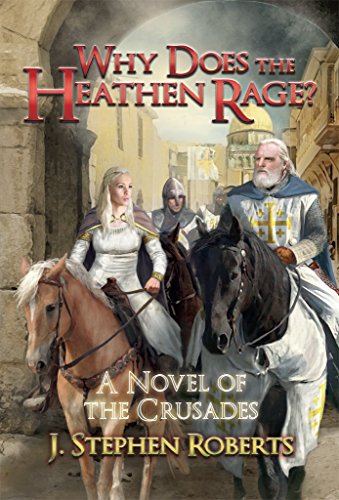
Armenian Christians play a key role in Why Does the Heathen Rage


Thursday, February 2, 2017

The Crusader States: An Overview

The Arms of the Kingdom of Jerusalem


The first crusade re-established Christian rule over some parts of the Holy Land, notably Antioch and Jerusalem, but the Western knights and noblemen who finally made it to Jerusalem felt they had been betrayed by the Byzantine Emperor.  Instead of returning the territory they had captured to Byzantine control, the crusaders established a series of independent states with Christian rulers: the Principality of Antioch, the County of Edessa, the County of Tripoli, and – most important – the Kingdom of Jerusalem. (Later, during the Third Crusade, the Latin Kingdom of Cyprus was also established, but that will be dealt with in a separate entry.) Dr. Schrader provides a brief history.

Initially, these "kingdoms" were little more than Christian-controlled islands in an Islamic sea, separated from one another by large swaths of territory. Between 1099 and 1144 the Christians steadily increased their area of control -- in most cases giving the defeated Muslim defenders of cities and castles a safe-conduct after surrender. By 1144, the crusaders controlled the entire coastline of the Levant from south of Gaza to roughly Antalya. In short, the crusader kingdoms covered all of what is now Israel, most of modern Jordan, Lebanon, and parts of Syria and Anatolia as well.

Likewise, initially there was only a tiny elite of Latin Christians, dependent economically on the local population composed predominantly of Melkite (both Greek and Arabic speaking), Jacobite, Maronite and Armenian Christians, with smaller populations of Jews, Samaritans, and Muslims. However, with the establishment of Christian control over the Holy Land a wave of immigration from Western Europe began. By 1180, an estimated 20% of the population was composed of settlers from the West – all speaking a variety of languages - including second and third generation immigrants descended from early settlers.

These "crusader states" were distinctly different from the feudal societies from which the founders of these states stemmed. To be sure, leaders of the First Crusade sought to recreate familiar structures and customs, but they had to adapt these to the unusual circumstances in which they found themselves. The result was a hybrid-society composed of diverse elements, many of which were found nowhere else in the medieval world.

In future entries, Real Crusades History will explore the following unique features of the crusader states: 1) the elected kingship and the role of the High Court; 2) the high status, power and independence of women, 3) the multi-cultural, multilingual native population; 4) the "sergeants" and settlers that  made up the backbone of the feudal army 5) the urban economy, 6) a rural economy based on trade,  7) the sophisticated administrative apparatus, 8) the complex legal system; 9) the militant orders, and last but certainly not least 10) the powerful, educated and independent knights.  

The Cloisters at the Church of the Nativity in Bethlehem: A Crusader Legacy
Dr Helena P. Schrader holds a PhD in History.
She is the Chief Editor of the Real Crusades History Blog.
She is the author of numerous books both fiction and non-fiction, including a three-part biography of Balian d'Ibelin.
In my three part biography of Balian d'Ibelin I endeavor to portray the crusader society as accurately as possible.


Buy now!                                         Buy now!                                        Buy now!