+ Real Crusades History +

+ Real Crusades History +
Showing posts with label Second Crusade. Show all posts

Friday, February 1, 2019

The Second Crusade and Its Consequences

Less than a half century after the re-capture of Jerusalem by Christian forces, the new crusader states suffered their first set back. In 1144, the Principality of Edessa was captured by Saracen forces. By 1146 the Principality of Antioch was also threatened, and an appeal went out. The appeal was made not to the Byzantine Emperor, who was deemed untrustworthy by the Latins at this time, but to the West. It had been the Latin world that had provided the forces that had taken Jerusalem in 1099;  it was with the ruling elites in above all in France, England and the Holy Roman Empire that the nobles of Outremer retained cultural, linguistic and family ties.

This call for help elicited an enthusiastic response. For the first (but not the last) time, kings were persuaded to take the cross (i.e., the crusader vow). The Holy Roman Emperor, Conrad III, and the King of France, King Louis VII, both promised to raise armies to come to the aid of the Holy Land. Their efforts have gone down in history as the "Second Crusade."
  
Conrad, the Holy Roman Emperor, raised about 80,000 troops and set out first. The French left later with an estimated 100,000 men. Notably, however, when the King of France knelt before Bernard of Clairvaux to take his crusader vows, he was joined by his queen, Eleanor of Aquitaine, who likewise knelt and took the cross. Eleanor did so as the Duchess of Aquitaine and Countess of Poitou – not as Queen of France. The importance of her gesture was to muster support among the barons and lords who owed her, but not Louis of France, homage.


However, Eleanor’s example inspired many other French noblewomen to take the cross as well.  So when King Louis’ crusaders set forth on their crusade, his army included an unnamed number of ladies – or “amazons” as some liked to call them – determined to take part in the crusade themselves.  Most of these women were the wives of noble crusaders, wealthy enough to afford horses and armor, since according to a Greek chronicler writing some fifty years after the event, they rode astride and wore armor.  They were also accompanied by servants and a great deal of baggage.

The first stages of this crusade went remarkably well for the French, with the army making good progress.  Although accounts differ on the extent to which Louis was able to prevent pillaging and abuse of the civilian population along the route, it is clear that the French intention was to pay for provisions and leave the Christian populations in peace. Unfortunately, the German crusaders under Conrad III had behaved rather more badly when they passed through ahead of the French so that the French often found the cities closed to them, and the price for goods exorbitant.

Nevertheless, the French reached Constantinople in comparatively good order, and while the common soldiers encamped outside the walls, the nobles, including Eleanor and her ladies, were introduced to the luxuries and splendors of the fabled Queen of Cities. They were lodged in palaces the like of which they had never seen before. They were feted and entertained. 

The news that the Byzantine Emperor had just concluded a 12 year truce with the Turks, however, cast serious doubts upon his reliability.  The mistrust of the Greeks only increased when the Byzantine Emperor tried to make Louis swear to turn over any territories his army conquered to the Emperor. Louis thought he had come to fight the Turks and restore Christian rule – not expand the borders of the Byzantine Empire.  Nevertheless, Louis rejected calls by some of his advisors to capture Constantinople and depose the Greek emperor.  Instead he set out for Jerusalem determined to fulfill his crusading vow – and consult with the King of Jerusalem about further action.

Louis chose to proceed along the southern, coastal route at a leisurely pace until, at the end of October, his army encountered deserters from the German crusade. These reported that the Turks had all but annihilated the Germans and now lay in wait for the French.  A few days later, the French caught up with what was left of the Germans, including Emperor Conrad, who was suffering from a head wound. Together Louis and Conrad’s crusaders followed the Mediterranean coast, finally reaching Ephesus in time for Christmas. Here, however, Conrad decided he was too ill to continue, so he and his nobles took ship back for Constantinople, while what was left of the foot soldiers continued with Louis’s army.

No sooner had the German Emperor departed, than adversity struck the French. Torrential rains lasting four days washed away tents, supplies, and many men and horses. After this catastrophe, Louis elected to strike out inland across the mountains, despite the absence of guides, in an attempt to reach Antioch as soon as possible.  This route, however, crossed through rugged terrain and along bad roads, where the French were constantly harassed by Turkish raiders. By now, at the latest, the “gayness and the gilt” of Eleanor and her lady-crusaders (or amazons) were “all besmirched with rainy marching in the painful field.”

The quote is from Shakespeare's "Henry V." Above Kenneth Brangh in the title role.
Disaster, however, did not overtake them until mid-January, when the commanders of the van took fatal independent action.  They had been ordered to set up camp for the main army at a specific place, and Eleanor was sent with them. (Throughout the crusade, King Louis maintained separation from Eleanor in order not to be tempted to break his vow of chastity during the duration of the crusade.) When the main army reached the designated camp, however, they found it empty. The vanguard with the Queen had decided to move to a more attractive-looking spot down in the valley. The exhausted troops at the rear, including the King with Eleanor’s baggage train, could not possibly catch up and as darkness fell a large gap had been opened between the Christian forces. The Turks quickly exploited the situation. They attacked the main force. The fighting was so intense and close that Louis’ horse was killed under him. Chronicles claim that some 7,000 crusaders died before darkness fell, putting an end to the slaughter. Many in the army blamed Eleanor, because it was one of her most important vassals who had left the main French army in the lurch.

After this disaster, the French returned to the coast, now determined to continue the crusade by ship. They were without supplies, however, and soon reduced to eating their horses before what was left of Louis’ force finally reached Antalia on January 20, 1148.  Here they discovered it was impossible to find sufficient ships for the whole force at prices King Louis was willing to pay. Plague broke out in the crusader camp, decimating a force already on the brink of starvation. At this junction, King Louis VII (not to be confused with his namesake and future saint, Louis IX) abandoned his troops and took ship with his wife and nobles for Antioch. Abandoned by their king, some 3000 French crusaders are said to have converted to Islam in exchange for their lives and food.

Louis and Eleanor, meanwhile, arrived in Antioch. Antioch was a magnificent, walled city, which had been one of the richest in the Roman Empire. At this time it was inhabited by a mixed population of Greek and Armenian Christians ruled by a Latin Christian elite, headed by Raymond of Poitiers, the younger brother of Eleanor’s father, William Duke of Aquitaine. The language of the court at Antioch was Eleanor’s own langue d’oc, and the customs were likewise those of the Languedoc. Within a very short time, Eleanor and her uncle developed such rapport that the king became jealous and then suspicious. The clerical chroniclers are united in condemning Eleanor of forgetting her “royal dignity” – and her marriage vows.

The situation was aggravated by the fact that Raymond of Antioch thought the crusaders had come to restore Christian control over the county of Edessa – and so secure his eastern flank. Louis, in contrast, thought he had come on pilgrimage to Jerusalem and insisted on continuing to the Holy City, rather than following the Prince of Antioch’s military advice. At this junction, with Louis already jealous of Eleanor’s close relationship (sexual or not) with Prince Raymond, she announced that she – and all her vassals – would remain in Antioch, whether the King of France went to Jerusalem or not. Since her vassals made up the bulk of what was left of the French forces, this was an effective veto. Louis threatened to use force to make her come with him as was his right as her husband. Eleanor retorted their marriage was invalid because they were related within the prohibited degrees and demanded an annulment. Louis responded by having her arrested in the middle of the night and carried away from Antioch by force.

After the French King's arrival in Jerusalem, the crusaders, local barons and military orders met to decide on the best strategy for action against the enemy. Although the author of the decision is not clear, the fateful decision was made to try to seize Damascus. The logic was that this would relieve the pressure on the narrowest part of the crusader kingdom -- the lands between Tyre and Tripoli. Ironically, the Muslim ruler of Damascus was one of the Saracen leaders, who had been willing to compromise and negotiate with the crusader kingdoms. The siege made an enemy of a former ally and pushed him into the arms of the jihadists -- which wouldn't have been disastrous if the campaign had been successful.  However, although a siege was established, squabbles among the leaders and then news that a strong Saracen relief army was on the way spread so much panic among the crusaders that the crusading army disintegrated. They had made a new enemy for nothing and squandered the reinforcements from the West.

Worst of all, however, was that this humiliating failure profoundly damaged the entire concept of crusades and crusading in the West.  It demonstrated that “God” was not inherently on the side of the crusaders and that victory was not assured. It also helped restore both unity and confidence among the Saracen leaders.

As a footnote, Queen Eleanor spent the months in Jerusalem while her husband’s crusade came to its final humiliating end outside Damascus. Although nothing is recorded of her activities, clearly her influence on Louis and her role in the crusade was over. Furthermore, despite an attempt to patch up the marriage after their return to France, the birth of a second daughter made a divorce a dynastic priority.  Louis abrogation of Eleanor, however, paved the way for her to marry Henry of Anjou, the future King Henry II of England. Eleanor's rich lands were instrumental in giving the Plantagenet king the means to challenge the Capets for dominance on the continent of Europe throughout the next half-century.
 Dr. Helena P. Schrader holds a PhD in History.
She is the Chief Editor of the Real Crusades History Blog.
She is an award-winning novelist and author of numerous books both fiction and non-fiction. Her three-part biography of Balian d'Ibelin won a total of 14 literary accolades. Her most recent releases are a novel about the founding of the crusader Kingdom of Cyprus and a new series on the baronial revolt against Frederick II. 


                                                                Buy Now!

Wednesday, December 13, 2017

True Tales of the Knights Templar 1: The Second Crusade

+Real Crusades History+ is dedicated to remembering the real contribution of the Knights Templar to the history of the crusades. 
Dr. Schrader continues our fifteen-part series on the Knights Templar with the first of our "Ten True Tales of the Knights Templar."  Today's essay looks at the role of the Knights Templar in the Second Crusade.


It was not until nearly two decades after the successful end of the First Crusade in 1118 that a handful of knights sought out the Patriarch of Jerusalem with an unusual request. These men wanted to take vows of poverty, chastity and obedience in exchange for devoting themselves to the service of God in an exceptional way.  Rather than withdrawing from the world and living a monastic life, they proposed (or according to Malcolm Barber, p. 7, accepted a proposal) to serve God by protecting unarmed pilgrims at risk of attack by robbers and Saracens while visiting the holy sites. The King of Jerusalem, welcomed this endeavor and agreed to give them space inside his palace, which was then located on the Temple Mount in Jerusalem, in what was then thought to be the site of King Solomon’s Temple and residence. It was from this building that the Templars drew their name “the Poor Knights of the Temple of Solomon in Jerusalem.”  They were at this time so poor that they wore only cast-off clothing donated by the pious, and allegedly did not have enough horses to go around, resulting in their early seal showing two knights on a single horse.


However, founding members had powerful and wealthy relatives and connections. More important the attracted some powerful early recruits, notably Hugh, Count of Champagne, who joined the nascent order in 1125. Other nobles, not willing or able to take vows of chastity and poverty, showed their veneration for what the Poor Knights were trying to do by leaving land or revenues to them. Yet arguably their greatest asset in the first two decades after their founding was ties through one of their founding members, Hugh of Payns, to St. Bernard of Clairvaux ― the most influential churchman of the early 12th century.


It was not until 1129, however, that at the Council of Troyes that the “Poor Knights” received a monastic code, a “Rule” by which they were to live, and Papal sanction for their now official, religious order.  The Rule was drafted by none other St. Bernard and based on the Rule of the Cistercians, but differing as necessary to allow the knights to look after their armor, horses, and operate on highways rather than living in the seclusion of a monastery.  In fact, the exact wording of the Rule was developed in a large committee that included several of the knights themselves.  It was at this time that the Poor Knights (who were increasingly rich as an Order, although poor as individuals) adopted white robes and surcoats as their habit.  The exclusive right to wear a red cross patée on their shoulders and/or breast was granted 17 years later in 1147.


Yet despite their success with gaining recognition, property and recruits, the Knights Templar (as they increasingly came to be called) had not yet emerged as a significant military establishment nor proven their worth in battle. It was the Second Crusade that gave them that opportunity.


The loss of the County of Edessa to the powerful Selkjuk leader Zengi in 1144 shocked Western Europe and triggered a call for a new crusade. Pope Eugenius made the official appeal, while St. Bernard became the most passionate, articulate and effective preacher of this new crusade. Although St. Bernard succeeded in recruiting the German King, Conrad of Hohenstaufen, from the start the driving force behind this crusade was the young French King, Louis VII. Louis had in childhood been destined for the Church and only became heir to the crown of France after his elder brother’s death. Throughout his life, he was noted for his great piety, and the crusade appealed to him greatly.  After an impassioned speech by St. Bernard at Vézélay on Palm Sunday 1147, enough nobles (including the Duchess of Aquitaine, wife of King Louis) had been recruited to make the crusade viable.


From the start, however, the crusade suffered from poor coordination. The German crusaders set off ahead of the French and proceeded in such an undisciplined fashion across the Western territories of the Byzantine Empire that it came to many armed clashes with Imperial troops.  The French followed a month behind the Germans and although more disciplined, they now encountered inhabitants burned by the behavior of the Germans who were hostile ― which meant reluctant to sell food and other necessities. The situation was critical and King Louis sent envoys to the Greek Emperor to negotiate for market privileges in exchange for an orderly passage of the crusaders through Byzantine territory.


One of Louis’ envoys was the Master of the Temple in France (not to be confused with the Grand Master.) This was a certain Everard de Barres, already a close confidante of King Louis, and commander of 130 Templar Knights and probably equal numbers of sergeants and support elements for a total of about 300 Templars. These Templars were presumably all recent recruits from France, but they had had time to undergo training and indoctrination. From the start of the Second Crusade, they appear to have assumed their now traditional role of protecting pilgrims ― in this case armed pilgrims and their very large baggage train including the Queen of France and many other ladies.  


After crossing the Bosporus in late October, the French crusaders received alarming reports of the destruction of the German crusader ― rumors that soon proved all too true. The German has been all but annihilated near Dorylaeum (the site of a great crusader victory in the First Crusade).  Allegedly only one in five of the German crusaders escaped the slaughter. Conrad von Hohenstaufen preferred to blame “betrayal” by the Greeks rather than take responsibility for his own poor leadership and failure to send out scouts. It was the message of “betrayal” that he gave King Louis.


Although the remnants of the Germans now joined the French, Conrad himself soon fell ill and returned by ship to Constantinople.  The French continued more cautiously along the coastal road.  Two days beyond Laodicea the road led through a steep pass over Mt. Cadmus.  The vanguard was ordered to camp at the top of the pass to give the rest of the army time to catch up, but the commander (a vassal of the Queen of France rather than her husband) ignored the orders and continued over the pass allowing a large gap between units to develop. The Turks, who had been shadowing the army all along, immediately took advantage of the situation and fell upon the main and rear divisions, still struggling up the slope.  King Louis was unhorsed early on and too refuge either among the rocks or up a tree (depending on account). In the ensuing slaughter and chaos, the Templars distinguished themselves as the only disciplined fighting force capable of delivering counter-blows. When darkness fell, the Turks had been driven back, but not before the crusaders had suffered severe losses, particularly to the horses and baggage train.


Shaken by his experience, King Louis effectively turned the command of his entire army over to the Templars!  Everard de Barres organized the crusader force into units of 50, each under the command of a single Templar.  The Templars established an order of march and insisted that it be maintained. They also gave orders for the infantry to protect the horse during attacks and that ensured that no counter attacks were undertaken until ordered and properly coordinated and led.  These were simple things, but they had evidently not been instituted prior the Templars taking command ― in sharp contrast to the highly disciplined army of Richard the Lionheart half a century later.


Yet discipline is not substitute for food and fodder. The Turks employed a form of “scorched earth” policy to deny the advancing crusaders both.  Soon the crusaders were eating their horses ― except for the Templars, who had husbanded their supplies and could still feed both themselves and their mounts. This enabled the Templars to disguise the weakness of the entire force ― and beat off four more attacks by the Turks before the crusaders finally reached the Byzantine controlled port of Adalia. (Howarth, p.88)


Here King Louis VII ignominiously (and unlike his descendant and namesake King Louis IX) promptly abandoned his army, and took ship for Antioch with his wife and his leading nobles. The common crusaders were left to die of plague and hunger or sell themselves into Turkish slavery in order to survive.


King Louis arrived in Antioch in March 1148 with none of his infantry and in desperate need of money. The Templars were now to prove their value in the second field of endeavor or which they were to become famous (or infamous, depending on your point of view): as bankers.  Everard des Barres sailed from Antioch to Acre and there managed to raise loans by mortgaging Templar properties. The sums raised were enormous, as King Louis’ instructions to his ministers in France to repay the Templars document that they amounted to nearly half the annual revenues of the King of France at this time. (Barber, p. 68)


The rest of the Second Crusade was equally disastrous. At Acre on June 24, 1148 a joint decision was taken by the leaders of the crusade including Conrad of Hohenstaufen (who had sailed from Constantinople directly to the Holy Land and joined the crusader council), King Louis and King Baldwin of Jerusalem to attack Damascus. The choice seems odd since the Sultan of Damascus at this time had been comparatively friendly and was a joint enemy of Zengi’s successor Nur ad-Din. Although the Masters of both the Temple and the Hospital were present at this war council, their opinions are not known, and their voices were not yet powerful enough to be decisive.  


Initial assaults on Damascus from the East/South were thwarted because the city was here surrounded by gardens and orchards with irrigation ditches that prevented the use of mass cavalry charges but provided archers with effective cover. The decision was therefore taken collectively to move the besieging army to the east where there were no such gardens and orchards ― but where there was also a dearth of water. Thereafter, the entire crusade broke down into bickering and recriminations while the crusading army disintegrated ― destroying the reputations of King Louis and Conrad of Hohenstaufen both.


The failure of the Second Crusade had serious repercussions.  It proved that “Frankish” knights were not invulnerable and Frankish armies not invincible. This greatly bolstered confidence among the Turks. In Western Europe it proved that God was not always on the side of the crusaders.  But since God had to be on their side, the search for scape goats was on at once.  The most obvious scapegoat was the Greeks. Both Conrad and Louis felt they had been “betrayed” ― misled at best or intentionally led into ambushes at worst. Another scapegoat were the “Poulains” ― the barons and lords of the Kingdom of Jerusalem ― who seemed to the crusaders too ready and willing to make truces with their Saracen foes.


Yet as Barber points out it is ominous that one German chronicler pinned the blame for the disaster at Damascus on the Templars. The Templars, he claimed, had accepted a massive bribe from the Saracens to give secret aid to the besieged (Barber, p. 69). It is notable that this allegation came only from German sources and not from French. King Louis returned to France full of praise for the Templars, and their reputation there continued to grow.  The Templars never really put down strong roots in the German speaking world and within half a century, the Germans would found their own Order, the Deutsche Ritter Orden. Yet it would be a French king who destroyed the Templars.


Join Dr. Schrader next week for the second in our series Ten True Tales of the Knights Templar.


Dr. Helena P. Schrader holds a PhD in History.
She is the Chief Editor of the Real Crusades History Blog.
She is an award-winning novelist and author of numerous books both fiction and non-fiction. Her three-part biography of Balian d'Ibelin won a total of 14 literary accolades. Her most recent release is a novel about the founding of the crusader Kingdom of Cyprus. You can find out more at: http://crusaderkingdoms.com

Thursday, February 9, 2017

Eleanor of Aquitaine on Crusade

“I dressed my maids as Amazons and rode bare-breasted halfway to Damascus. Louis had a seizure and I damn near died of windburn, but the troops were dazzled.”
 Eleanor of Aquitaine in the 1967 film “The Lion in Winter” starring Peter O’Toole and Katherine Hepburn.


As with most good historical fiction, there is more than a grain of truth to this fictional line from The Lion in Winter. Not only did Eleanor of Aquitaine take part in the Second Crusade, her role soon became  controversial and her participation precipitated a marriage crisis. Dr. Schrader provides a summary of what really happened.

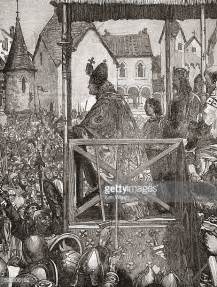
In 1144, the crusader County of Edessa was overrun by the atabeg of Mosul, Zengi.  The news shocked Western Europe and Pope Eugenius III called for a new crusade. St. Bernard of Clairvaux enthusiastically took up the call, and at the pope’s bidding preached the crusade far and wide, including on Easter Sunday in Vezelay, Burgundy.  Here King Louis VII of France knelt before the abbot and took the cross to the thunderous cheers of his vassals and subjects. When he finished, his queen, Eleanor of Aquitaine, knelt beside him and likewise took the cross.

Eleanor did so as the Duchess of Aquitaine and Countess of Poitou – not as Queen of France. The importance of her gesture was to muster support among the barons and lords who owed her, but not Louis of France, homage.  However, Eleanor’s example inspired many other noblewomen to take the cross as well. 
When King Louis’ crusaders set forth on their crusade, the estimated 100,000 French included an unnamed number of ladies – or “amazons” as some liked to call them – determined to take part in the crusade themselves.  Far from being Eleanor’s “maids,” most of these women were the wives of noble crusaders, wealthy enough to afford horses and armor, since according to a Greek chronicler writing some fifty years after the event, they rode astride and wore armor.  They were also accompanied by servants and a great deal of baggage.
Depiction of Eleanor of Aquitaine in a German 12th century Manuscript
The first stages of this crusade went remarkably well, with the army making good progress.  Although accounts differ on the extent to which Louis was able to prevent pillaging and abuse of the civilian population along the route, it is clear that the French intention was to pay for provisions and leave the Christian populations in peace. Unfortunately, they were preceded by German crusaders under the Holy Roman Emperor Conrad III that behaved so badly the French found all the cities closed to them, and the price for goods exorbitant.
Nevertheless, they reached Constantinople in comparatively good order, and while the common soldiers encamped outside the walls, the nobles, including Eleanor and her ladies, were introduced to the luxuries and splendors of the fabled Queen of Cities. They were lodged in palaces the like of which they had never seen before, feted and entertained. 
The news that the Byzantine Emperor had just concluded a 12 year truce with the Turks, however, cast serious doubts upon his reliability.  The mistrust of the Greeks only increased when the Byzantine Emperor tried to make Louis swear to turn over any territories his army conquered to the Emperor. Louis thought he had come to fight the Turks and restore Christian rule – not expand the borders of the Byzantine Empire.  Nevertheless, Louis rejected calls by some of his advisors to capture Constantinople and depose the Greek emperor.  Instead he set out for Jerusalem determined to fulfill his crusading vow – and consult with the King of Jerusalem about further action.
The French crusaders advanced along the southern, coastal route at a leisurely pace until at the end of October they encountered deserters from the German crusade, who reported that the Turks had all but annihilated the Germans and now lay in wait for the French.  A few days later, the French caught up with what was left of the Germans, including Emperor Conrad, who was suffering from a head wound. Together Louis and Conrad’s crusaders followed the Mediterranean coast, finally reaching Ephesus in time for Christmas. Here, however, Conrad decided he was too ill to continue, so he and his nobles took ship back for Constantinople, while what was left of the foot soldiers continued with Louis’s army.
No sooner had the German Emperor departed, than adversity struck the French. Torrential rains lasting four days washed away tents, supplies, and many men and horses. After this catastrophe, Louis elected to strike out inland across the mountains, despite the absence of guides, in an attempt to reach Antioch as soon as possible.  This route, however, was not only through rugged terrain and along bad roads, but took the French where they were constantly harassed by Turkish raiders. By now, at the latest, the “gayness and the gilt” of Eleanor and her lady-crusaders (or amazons) were “all besmirched with rainy marching in the painful field.”
Disaster, however, did not overtake them until mid-January, when two Poitevin nobles in command of the van took fatal independent action.  They had been ordered to set up camp for the main army at a specific place, and Eleanor was sent with them. (Throughout the crusade, King Louis maintained separation from Eleanor in order not to be tempted to break his vow of chastity during the duration of the crusade.) When the main army reached the designated camp, however, they found it empty. The vanguard of Poitevins with the Queen had decided to move to a more attractive-looking spot down in the valley. The exhausted troops at the rear, including the King with Eleanor’s baggage train, could not possibly catch up and as darkness fell a large gap had been opened between the van and main force of the Christians. The Turks quickly exploited the situation. They attacked the main force, killing Louis’ horse under him and some 7,000 crusaders before darkness fell, putting an end to the slaughter. Many in the army blamed Eleanor, because it was her vassals who had left the main French army in the lurch.
After this disaster, the French returned to the coast, now determined to continue the crusade by ship. They were without supplies, however, and soon reduced to eating their horses before what was left of Louis’ force finally reached Antalia on January 20, 1148.  Here they discovered it was impossible to find sufficient ships for the whole force at prices King Louis was willing to pay. Plague broke out in the crusader camp, decimating a force already on the brink of starvation. At this junction, King Louis VII (not to be confused with his namesake and future saint, Louis IX) abandoned his troops and took ship with his wife and nobles for Antioch. Abandoned by their king, some 3000 French crusaders are said to have converted to Islam in exchange for their lives and food.
Louis and Eleanor, meanwhile, arrived in Antioch. Antioch was a magnificent, walled city, which had been one of the richest in the Roman Empire. At this time it was inhabited by a mixed population of Greek and Armenian Christians ruled by a Latin Christian elite, headed by Raymond of Poitiers, the younger brother of Eleanor’s father, William Duke of Aquitaine. The language of the court at Antioch was Eleanor’s own langue d’oc, and the customs were likewise those of the Languedoc. Within a very short time, Eleanor and her uncle developed such rapport that the king became jealous and then suspicious. The clerical chroniclers are united in condemning Eleanor of forgetting her “royal dignity” – and her marriage vows.
The situation was aggravated by the fact that Raymond of Antioch thought the crusaders had come to restore Christian control over the county of Edessa – and so secure his eastern flank, but Louis thought he had come on pilgrimage to Jerusalem and insisted on continuing to the Holy City, rather than following the Prince of Antioch’s military advice. At this junction, with Louis already jealous of Eleanor’s close relationship (sexual or not) with Prince Raymond, she announced that she – and all her vassals – would remain in Antioch, whether Louis went to Jerusalem or not. Since her vassals made up the bulk of what was left of the French forces, this was an effective veto. Louis threated to use force to make her come with him as was his right as her husband. Eleanor retorted their marriage was invalid because they were related within the prohibited degrees and demanded an annulment. Louis responded by having her abducted in the middle of the night and carried away from Antioch by force. 
Although Eleanor then spent several months in Jerusalem while her husband’s crusade came to its final humiliating disaster outside Damascus, nothing is recorded of her activities.  Her influence on Louis and her role in the crusade was over. Furthermore, despite an attempt to patch up the marriage, after their return to France, the birth of a second daughter made a divorce a dynastic priority, paving the way for Eleanor to marry Henry of Anjou, the future King Henry II of England.
(Truly, fiction does not get better than facts like these!)
There are many biographies of Eleanor, I personally relied on Alison Weir’s Eleanor of Aquitaine: By the Wrath of God, Queen of England, (London, Pimlico, 1999), and Amy Kelly’s Eleanor of Aquitaine and the Four Kings, (Cambridge, Mass, Harvard University Press, 1950). There are innumerable novels about Eleanor. I have not read them all and the ones I did read, failed to do her justice, so I’ll refrain from a recommendation.

Eleanor’s Tomb at the Abbey of Fontevrault

Dr Helena P. Schrader holds a PhD in History.
She is the Chief Editor of the Real Crusades History Blog.
She is the author of numerous books both fiction and non-fiction, including a three-part biography of Balian d'Ibelin.