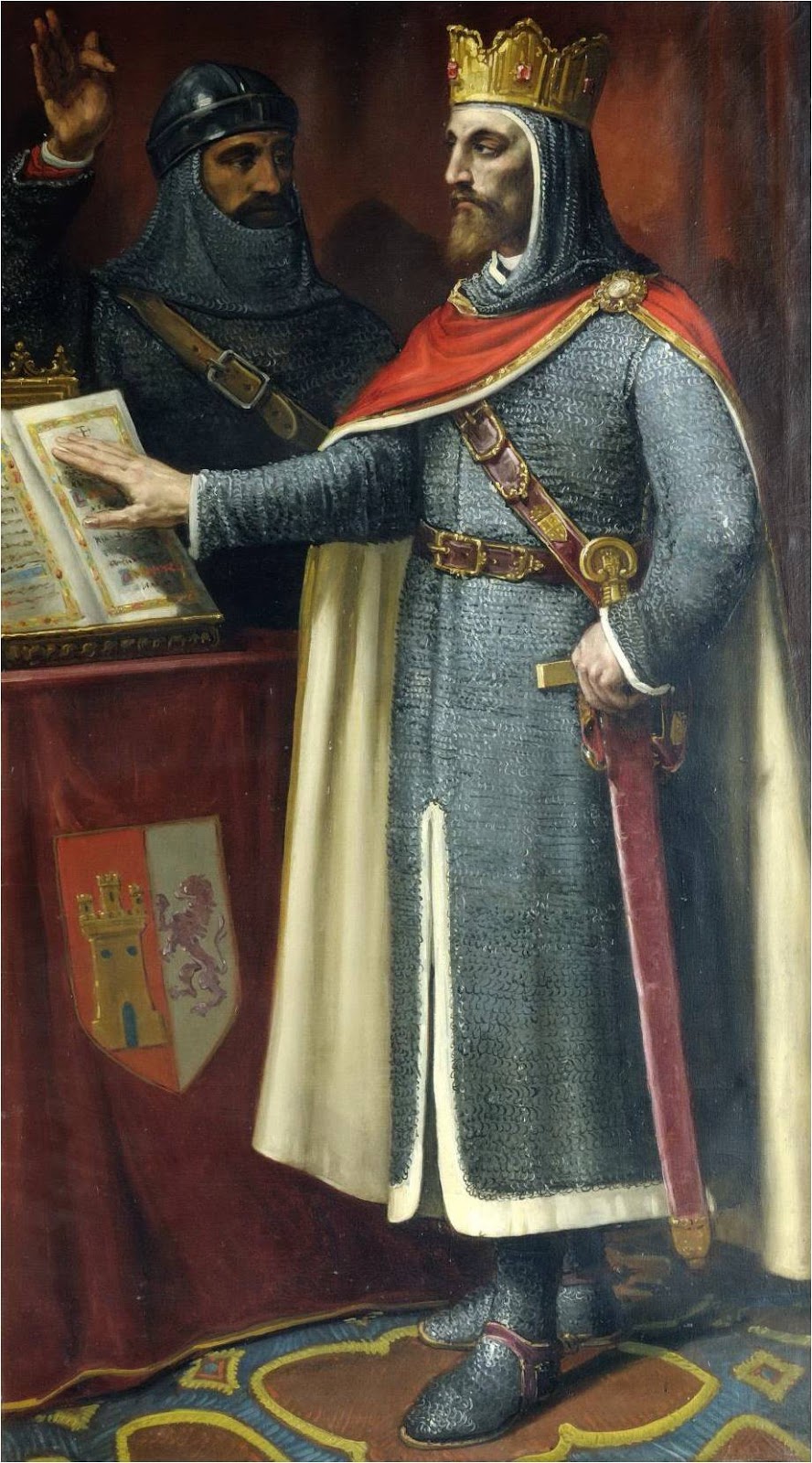
Toward the end of his reign, Alfonso the Battler had conquered enormous portions of the Moors’ Ebro Frontier. By 1132, Alfonso felt ready to push on to Lérida and Fraga. He assembled an impressive coalition army of Aragonese, Navarrese, and French troops. By 1133 Alfonso took control of the Mohammedan fortress of Mequinenza, and he besieged Fraga.
The siege of Fraga was long and difficult, especially due to the capable leadership of Abd Allah ibn-Iyad, the governor of Lérida, who harassed Alfonso’s efforts as much as possible. The siege dragged on over a year: a testament to Alfonso’s abilities as a general, since he managed to hold together disparate forces for a long period of time.
Realizing the enormous danger posed by Alfonso’s campaign, the Almoravid governor of Valencia, ibn-Ganiya attempted to relieve Fraga twice. The first time, in early 1134, ibn-Ganiya was defeated. But later that year, ibn-Ganiya came up with a new plan. On July 17, 1134, ibn-Ganiya’s Almoravid army attacked Alfonso’s camp. When the Battler rallied his forces for a counterattack, the Moors of Fraga mounted a sally and attacked Alfonso’s troops from behind. The fighting that followed was hard, but the Almoravids gained the advantage. Alfonso’s army was devastated. His old ally, Centulle of Bigorre was killed, along with thousands of French and Spanish troops. Alfonso himself was wounded, but managed to escape with a group of knights, despite being doggedly pursued by the victorious Almoravids.
This victory was important psychologically for the Almoravids. After being defeated repeatedly by Alfonso the Battler for years, the Almoravids finally managed to take revenge on the conqueror of Zaragoza. The Almoravids did manage to make some temporary gains as a result of the victory, but the overall reality of Alfonso’s Ebro conquests remained. An attempt by the Moors to recapture Zaragoza in the wake of Fraga failed, and in the coming years Alfonso’s heirs would not only regain what was lost at Fraga, but push the Mohammedan frontier back even farther.
In the second decade of the twelfth century, Alfonso the Battler, King of Aragon and Navarre, made enormous gains against the Almoravids by conquering important portions of the Ebro River Valley, including the cities of Zaragoza and Tudela. The loss of Zaragoza was perhaps the greatest disaster for Iberian Islam since the passage of Toledo into Christian hands in 1085. Ali ibn-Yusuf, the Almoravid ruler, reacted by mustering an army to check Alfonso’s advance.
By the spring of 1120, the Battler had already put Calatayud to siege, and had even dispatched troops to capture Daroca. Ali ibn-Yusuf selected his brother, Ibrahim ibn-Yusuf, governor of Seville, to lead the expedition against the Aragonese. Ibrahim was one of Ali’s most trusted and talented generals, who had proven himself over the years in Iberian politics. Ibrahim marched his army toward Alfonso’s position, joined en-route by Mohammedan forces from Murcia, Granada, and Lérida. The full Almoravid army that then moved to attack Alfonso probably numbered around 2,500 cavalry and 5,000 infantry.
Alfonso's army annihilated the Almoravids at Cutanda
Alfonso had good intelligence on their approach, and mustered his troops for a counter-attack. In addition to Alfonso’s Aragonese and Navarrese troops, he had considerable French allies with him, including the army of Count William of Poitiers. This was a rare instance in which the Christian army may have slightly outnumbered the Mohammedan troops.
Alfonso took the Almoravids by surprise on June 17th near the village of Cutanda, in the Jiloca River Valley. A series of punishing cavalry charges led by the Battler himself utterly devastated the Almoravids. So total was the destruction visited upon the Mohammedan forces that for years afterwards a saying endured that the unlucky “were like the vanquished at Cutanda.” As a result, Calatayud and Daroca fell to the Christians. Alfonso the Battler’s conquests were some of the most devastating losses for al-Andalus during the early twelfth century. Never again would the Almoravids attempt to take the Frontera Superior from the Aragonese.
Ever since the loss of Toledo to
the Christians in 1085, a major goal of the Moorish powers of al-Andalus in
southern Spain had been to recapture that important Iberian city. In 1108, for
the first time in six years, a major Almoravid army set out to attack the Christian
territory of Toledo. This army was led by Tamin ibn-Yusuf, brother of the
Almoravid Emir Ali ibn-Yusuf. Tamin’s army included forces from Granada, Córdoba,
Murcia, and Valencia, making it a numerically enormous coalition.
For his first move, Tamin attacked Uclés,
some one hundred kilometers east of Toledo. The town itself fell on May 27, but
the castle resisted, obliging the Almoravids to dig in for a siege.
King Alfonso VI of León (1040, 1065-1109)
Meanwhile, King Alfonso VI of León
was well aware of the Almoravid invasion, and had already dispatched a relief
force. The Leonese were led by Count Álvar Fáñez, one of the King’s most
trusted commanders. Also included in the army was King Alfonso’s son and heir, Sancho
Alfónsez, for the first time taking a command role in a military expedition.
The Almoravid forces broke away
from their siege of the citadel at Uclés to meet the approaching Christians. On
May 29, just outside of Uclés, the two armies met. Álvar Fáñez may have engaged
the Moorish forces too soon, which allowed the numerically superior Almoravid
forces to flank the Christian troops. In the resulting battle, the Leonese army
was destroyed. Many high-ranking knights were killed, including the King’s son,
Sancho Alfónsez. Álvar Fáñez led the survivors out of the encirclement and
managed to retreat to Madrid.
Battlefield of Uclés as it appears today
Having won the field, the
Almoravids beheaded the Christian dead, which numbered in the thousands,
heaping the heads in a ghastly pile. An Almoravid imam then climbed up on top
of this mound of heads and preached the Koran to the victorious jihadi troops. The
Almoravid triumph meant that Uclés at once passed into Mohammedan hands, as
well as the entire south bank of the River Tajo from Aranjuez east to Zorita.
Toledo itself was in grave danger, but the Leonese mobilized a defense that
prevented the Almoravids from pushing their advance beyond the Tajo. Despite
this fantastic victory, Toledo – the ultimate prize – remained out of Almoravid
grasp.
The death of Prince Sancho Alfónsez
was personally devastating to King Alfonso VI, but also meant that his Kingdom
would have to confront the problem of succession. Ultimately the lack of a male
heir meant that the King’s daughter, Urraca, would take the throne.
The triumph of the First Crusade greatly
impacted the early-twelfth century Christian kingdoms of Iberia. Inspired by
Pope Urban II’s message of holy war, the knights and clergy of Spain began to
conceive of their centuries-long struggle against the Moors of al-Andalus as a
Crusade that merited spiritual benefit for its participants. A pioneer in this
movement was Alfonso I of Aragon (1104-1134), a tough warrior-king deeply moved
by the concept of Christian struggle against the infidel, who viewed himself as
a crusading monarch in the same vein as the Latin kings of Jerusalem in Outremer.
King Alfonso appealed to France for
assistance in his first proposed crusade. His target was Zaragoza, a formerly
independent Moorish city, which had in 1110 fallen to the powerful Almoravid
Empire based in North Africa. In 1118, Alfonso sent Bishop Esteban of Huesca to
the Council of Toulouse, where the French clergy confirmed “the way of Spain”
as an avenue for Crusade. Several French nobles responded to Alfonso’s appeal,
Gaston IV of Bearn (who had fought in the Holy Land), his brother Centulle of
Bigorre, and Bernard Ato of Carcassone all took the cross to aid the King of
Aragon, as did the Iberian nobles Diego Lopez de Haro, Lord of Vizcaya, and
Count Ramon of Pallars. The coalition French-Aragonese army marched on
Zaragoza, and the siege began May 22, 1118.
Alfonso I of Aragon
Later that same year, Alfonso sent Bishop
Pedro, already selected to rule the episcopate of Zaragoza, to meet with Pope
Gelasius II, who was touring southern France. Gelasius made a definitive
declaration on the Zaragozan Crusade: “If anyone receives penance for his sins
and is killed in this expedition, we, by the merits of the saints and the whole
Catholic Church absolve you from your sins.” -Reconquest and Crusade, p. 37. He
also offered “remission and indulgence of their sins” to those laboring “in the
service of the Lord,” confirming that anyone participating in Alfonso’s Crusade
would gain the same spiritual benefits as if he’d fought in the Holy Land. The
Pope also added a new innovation to this Crusade bull, granting an indulgence
to anyone who aided in the construction of the churches in Zaragoza.
In response to Alfonso’s siege, the
Almoravids dispatched a considerable army to relieve Zaragoza. Alfonso moved
out with his troops to counter the Almoravid advance, and on December 6th
the two forces met in battle. The result was an overwhelming victory for the
Crusaders, in which the Almoravid host was shattered. This made the fall of
Zaragoza inevitable: on December 18th, the Almoravid garrison
surrendered. Mohammedan citizens wishing to depart were granted safe passage,
while those opting to stay were free to do, provided they paid an annual tax to
the King of Aragon. In early 1119, Alfonso granted privileges to Christians
choosing to settle in Zaragoza. Over the next two years he captured the
fortresses of Tudela, Tarazona, Borja, Calatayud, and Daroca, extending his
frontier well south of the Ebro River.
In 1120 the Almoravids, eager to recover
their losses, launched another army against Aragon. Alfonso met them at
Cutanda, near Daroca, and once again the Christian army triumphed, with
Alfonso’s cavalry smashing the Almoravid lines.
Alfonso before the defeated Almoravids at Cutanda, 1120
Inspired by the newly founded Knights Templar
in Jerusalem, King Alfonso established his own order of warrior monks to defend
his conquests. In 1122 he installed the brothers at Castle Belchite, some
twenty-two miles south of Zaragoza. Described in the sources as a militia
Christi – army of Christ, the order mirrored the Templars in most respects. The
brothers took a monastic vow, with an additional oath to defend Christendom
against her enemies. In 1124 Alfonso established another community of brother
knights sixty miles south of Zaragoza at Monreal, a castle named after a
frontier fortress in the Kingdom of Jerusalem. In addition to charging these
knights with the defense of Christian Aragon, Alfonso gave this order the
extraordinary mission of eventually overcoming the Mohammedans of Africa and
opening another route to Jerusalem. We can see how deeply Alfonso was oriented
toward the concept of crusading, viewing his efforts in Iberia as working in
concert with the Crusader states in Syria and Palestine.
Next Alfonso embarked on a bold campaign of
raids deep into Almoravid territory. He ravaged from Valencia to Denia, Jativa
to Murcia, and even threatened Granada. In March of 1126 he encountered an
Almoravid army at Lucena, and there, in the heart of Moorish territory, won yet
another major victory. Thousands of Christians living in Mohammedan lands
rallied to Alfonso’s army, and traveled with him back to his kingdom, where
they settled in the Ebro valley.
Alfonso then campaigned to capture the
remaining Moorish castles in the Ebro valley. In 1133, carrying a relic of the
true cross, his army seized Mequinenza some sixty miles south of Zaragoza.
However, on July 19, 1134 he suffered his first and only defeat by the Moors at
the Battle of Fraga. Despite this final disappointment, the long legacy of
Alfonso’s many victories over the Moors had far reaching consequences. Most
importantly, his conquest of Zaragoza resulted in that great city never again
returning to Moorish control. Later that year, the great warrior King Alfonso
the Battler died on September 7th. His efforts had established
Aragon as a major power on the Iberian Peninsula. The famous chronicler
Ordericus Vitalis described Alfonso and his knights as “Christi crucesignatos”
– warriors signed with the cross of Christ – the medieval expression for
crusaders. And rightly so, for Alfonso’s ideological commitment to crusading
combined with his military successes helped solidify the Reconquista as an
Iberian Crusade.
Indeed, Alfonso was so committed to the ideal
of the Crusade, that in his will he bequeathed the whole of his Kingdom to the
Templars, the Hospitallers, and the Aragonese military orders he had
established in his domain.
Today we’re going to be talking about a pivotal moment in the Reconquista of Portugal: the Battle of Ourique.
In 1139 the County of Portugal was ruled by Afonso Henriques, the son of Henry of Burgundy, and Theresa, daughter of King Alfonso VI of Leon and Castile. At the time of his assumption to power, Afonso’s Portugal extended from the Miño River eastward to Braganza, and southward to Coimbra.
On its southern reaches, Portugal bordered territory controlled by the powerful Almoravid Caliphate of North Africa. In 1137, the Almoravids attacked the castle of Leiria, which Afonso had recently erected on the road from Coimbra to Santarém. Afonso quickly strengthened the fortifications of Leiria, and prepared to carry the war into Almoravid territory. In 1139 he mustered his army at Coimbra and struck south on a raid deep into Almoravid territory, which at one point may have even reached as far as Seville.
The extent of Afonso’s raid is striking, but Afonso had planned his route well, avoiding the well-fortified city of Santarem and scouting the region meticulously. Also, the Moorish city of Oreja was under siege by King Alfonso VII of Leon, and so considerable Almoravid forces were diverted to defend Oreja against the Leonese. It’s possible that Alfonso VII and Afonso Henriques had acted in concert with this mission to maximize damage to the Moors.
Meanwhile, the governor of Cordoba, Abu Muhammad Az-Zubayr Ibn Umar, mobilized an enormous army to check Afonso’s raid, drawing on troops from both North Africa and al-Andalus.
Afonso met the Almoravids near the village of Ourique southwest of Beja, far to the south of Portugal’s holdings in the Algarve. Afonso had with him just under a thousand Portuguese knights, including contingents of Templars, with roughly twice that number of infantry. The Almoravid army was much larger: eight to ten thousand troops. Five important Andalusian governors were present: the emirs of Seville, Elvas, Évora and Beja, including Ibn-Umar of Cordoba leading the operation.
Afonso I of Portugal
The Moors intercepted the Portuguese on July 24th. With his numerical superiority, Ibn-Umar cut off Afonso’s path of retreat, and the two armies prepared for battle.
The next morning, both sides arrayed their lines for combat. Afonso arranged his knights into a vanguard, two flanks, and a rearguard. The vanguard would’ve contained several hundred of the army’s best knights, while each flank had around two hundred knights and four to five hundred infantrymen. The rearguard contained the remainder of the cavalry and infantry units.
The Almoravid divisions contained light cavalry, infantry, and both mounted and un-mounted archers. They would’ve been arranged with a vanguard before a central column, with this entire formation augmented by two flanks. A rearguard was arranged behind this, with a reserve behind the rearguard.
Confident in his superior numbers, ibn-Umar ordered his vanguard to make the initial charge. The Portuguese responded by delivering a heavy cavalry charge, and the superiority of Latin cavalry had a major impact. The Christian knights held their formation against the Almoravid attacks, and delivered wave after wave of punishing cavalry charges. The superior armor and big, well-trained horses of the Latin knights, as well as their use of the couched lance tactic, which allowed their lance blows to carry the full weight of their charging stallions, devastated the Almoravid lines. As ibn-Umar’s formations broke up, the Portuguese rearguard charged through them, causing further devastation, and the Christian infantry cut down the survivors as they tried to flee.
By mid-day it was over: Afonso and his forces had won. The Moors fled, although we don’t know if ibn-Umar was able to effect an orderly retreat, or if his forces fled in disorder. The Portuguese remained for a further three days, pillaging the Almoravid camp. Afonso then returned to Coimbra.
It may have been Afonso’s victory at Ourique that prompted him to declare Portugal no longer a county, but now a kingdom. From here onward, Afonso would style himself rex Portugalensium – King of Portugal. Thus, by this great victory of the Reconquista, the Kingdom of Portugal was truly born as an entity.
Pledge $5 monthly or more to Real Crusades History on Patreon and get access to exclusive podcasts not available to the public!


.jpg)