+ Real Crusades History +

+ Real Crusades History +
Showing posts with label Castles. Show all posts

Friday, April 5, 2019

Castle of the Queen - Kantara Castle

The third castle in my series on crusader castles is, like St. Hilarion, located on Cyprus. Its foundations stretch back before the crusader period, but it played an important role in crusader times. It is also shrouded in mystery and legends in addition to being located in a spectacular landscape.

 The view up to the castle.

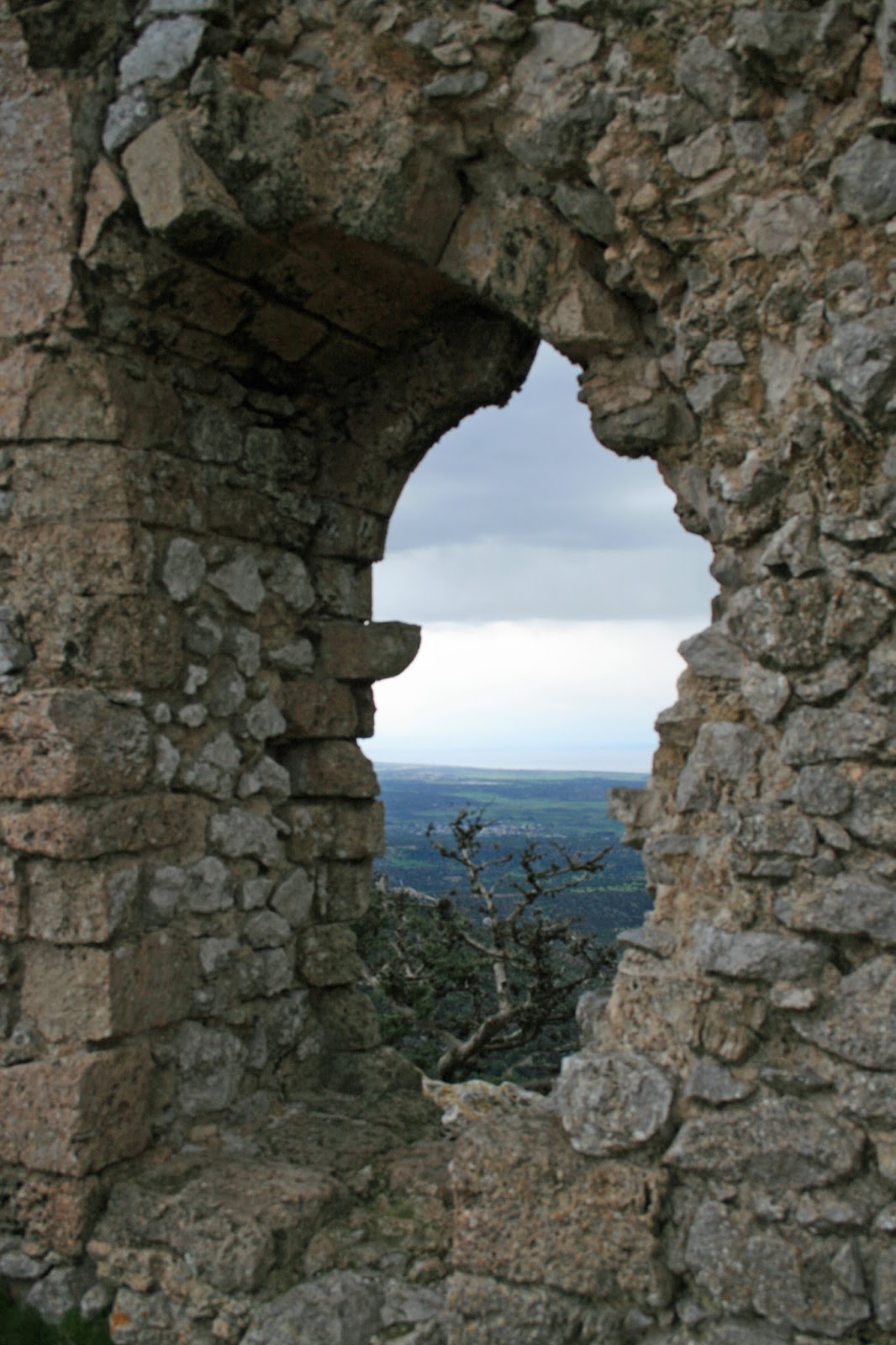
Kantara is located on the tip of a long, narrow ridge as the Kyrenia mountain range comes to an abrupt end overlooking the plain of Karpas. It sits 630 meters (2,067 feet) above the Mediterranean.

 And the View Down to the Sea

Although the fundamental structure was constructed under the Byzantine Emperor Alexius I Comnenus  after the Greek Empire re-established firm control over the island of Cyprus, the name is thought to derive from Arab the words "kandara" (high building) or "kandak" (castle).  This suggests there may have been an earlier structure, an outpost or watch tower, that occupied this strategic location before the Comnenus Emperor constructed a full-fledged castle. 

During Richard the Lionheart's invasion of Cyprus in 1191, Kantara served as a temporary refuge for the Greek tyrant Isaac Comnenus, and not even the great Lionheart made any attempt to take it.  Then again, he didn't need too. He captured the seaside fortress of Kyrenia instead and with it Isaac's beloved daughter. The tyrant submitted without any further resistance after his daughter's capture.

 
During the bitter wars between Emperor Friedrich II and the barons, on the other hand, the castle of Kantara was subjected to a long and brutal siege.   Defended by men loyal to the German emperor, the barons of Cyprus besieged the castle. Their forces were commanded by Anseau de Brie.  Brie built a trebuchet that, according to the contemporary chronicler and witness Philip de Novare (a fighting man in the service of the Ibelins), "battered down nearly all the walls."  While this was doubtless an exaggeration, Ibelin also reports that the bedrock on and into which the castle was built defied destruction.  Multiple attempts to assault the castle were successfully repulsed.


The castle only surrendered after ten months of siege due primarily to dwindling supplies and the demoralization of the garrison after the death of their commander, Gauvain de Cheneche. The latter was one of the five baillies appointed by Frederick II. (See: The Emperor's Men)

During the Genoese occupation of Cyprus in late 15th century, the castle was held for the crown and was twice attacked by Genoese forces. It resisted both assaults successfully, and became the base for counter-attacks, preventing Genoese control of the Karpas peninsula.


After the collapse of Lusignan rule on Cyprus and the establishment of Venetian control in the 16th Century, the castle was abandoned and began to decay.


Left behind were the impressive structures that gradually became ruins and the legends. The locals started to call it "the castle of a hundred chambers" -- although according to legend the 101st chamber contained a treasure that no one had ever found. Or, alternatively, the 101st chamber was enchanted and if one fell asleep in it, one woke up years later in a lovely garden. Another local name for the castle was "the house/residence of the queen" -- although no specific queen appears to be associated with the castle historically. 

The 19th century traveler D. Hogarth combines these themes suggesting: "...the traveler might imagine it the stronghold of a Sleeping Beauty, untouched by change or time for a thousand years."
Kantara certainly captured my imagination and my heart. It is the setting of many episodes of the (unpublished) "Lion of Karpas" and has a modest role in "The Last Crusader Kingdom" and "Rebels against Tyranny."


 Buy Now!                                             Buy Now!
 

Dr. Helena P. Schrader holds a PhD in History.
She is the Chief Editor of the Real Crusades History Blog.
She is an award-winning novelist and author of numerous books both fiction and non-fiction. Her three-part biography of Balian d'Ibelin won a total of 14 literary accolades. Her most recent release is a novel about the founding of the crusader Kingdom of Cyprus. You can find out more at: http://crusaderkingdoms.com


Thursday, March 7, 2019

St. Hilarion - The Stronghold of the Lusignans

In writing about Medieval Cyprus it is impossible to overlook the most powerful and dramatic of all the medieval fortresses: St. Hilarion. It is the setting of several key episodes in the history of 12th and 13th century Cyprus. Below is a brief history.


The castle stands 700 meters (2275 feet) above sea level on the narrow ridge of the Kyrenia range just slightly southwest of the port of Kyrenia.  It was built by the Byzantine governor of the island after the Comnenus emperors re-established full control over Cyprus in the late 10th. Constructed between 1102 and 1110, it was called Didymos by the Byzantines for the twin mountain peaks between which the upper castle sits.  The crusaders, however, preferred to call it the castle of "Dieu d'Amour" (the God of Love) and the locals continued to refer to it as St. Hilarion because the saint of that name had built a monastery, been buried and venerated here long before the castle was built. 

  Remnants of the Castle Church

The castle boasts three lines of defense and was never taken by assault. It was, however, frequently besieged. 

 View from the upper to the lower ward.

In July/August 1228, after Emperor Friedrich II accused John d'Ibelin of malfeasance and attempted to seize his fief without trial, Ibelin secured control of St. Hilarion, had it well provisioned and moved his supporters' dependents there in preparation for a confrontation.  Ibelin was persuaded to turn the castle over to the King of Cyprus in exchange for the release of his two hostage sons -- or vice versa, depending on how one interprets the negotiations.


When Friedrich II left the Holy Land for the West, he turned St. Hilarion over to his appointed baillies with orders for them to prevent the Ibelins from setting foot on the island. Within two months, however, the Ibelins had pulled together a sufficient army to challenge this (illegal) order head on. They landed on the south coast and routed the imperial forces at the Battle of Nicosia on July 14, 1229.  The surviving leaders of the imperial supporters fled to the three mountain castles, Kantara, Buffavento and St. Hilarion. A siege began almost that lasted nearly a year. Shortly after Easter in 1230, the Imperial forces surrendered to the Ibelins.


Just two years later, in May 1232, fortunes were reversed. The Imperial forces were on the offensive. With the Lord of Beirut, all his sons and the bulk of his knights struggling to relieve a besieged Beirut, the Imperial forces seized control of Cyprus.  The supporters of the Ibelins were forced to seek refuge in St. Hilarion and Buffavento, where they were soon subjected to a siege. Six weeks later, after defeating the Imperial forces at the Battle of Argidi on June 15, 1232, the Ibelins were able to lift the siege of St. Hilarion and rescue their women and children. 


A long period of peace followed this episode, and St. Hilarion was strengthened and embellished by the Lusignan kings to turn it into an idyllic summer residence high above the heat of the coast. In 1348, King Hugh IV retreated to the castle to escape not an enemy but the plague. During the later Genoese invasion, St. Hilarion was an important royal base of operations, the key to disrupting Genoese internal lines of communication.


After that, it lost relevance and fell into disrepair and finally ruin from the 16th century onwards.

St. Hilarion is the setting of important historical events described in "Rebels against Tyranny."


Thursday, January 10, 2019

Crusader Castles

One of the most impressive and visible legacies of the crusader kingdoms are the castles erected by Latin rulers in their territories.  Yet, T.E. Lawrence, famous as “Lawrence of Arabia,” disparaged the crusader castles as irrelevant and ineffective because these fortifications ultimately proved incapable of preventing the fall of the crusader kingdoms. 


This is too facile a judgment. In fact, the crusader castles enabled numerically small fighting forces to withstand repeated invasions by numerically vastly superior armies. Christian defeats in the first hundred years of the crusader kingdoms occurred almost exclusively in the open field, where Muslim leaders could bring their larger forces to bear, e.g. the Field of Blood (1119), Hattin, (1187). By contrast, when the crusaders retreated into their fortified cities or castles, forcing the Saracens to besiege them, they usually survived to fight another day. Yet even the strongest walls require defenders and when a castle like Krak de Cheveliers, built to be defended by 2,000 fighting men, had a garrison of only a few hundred, it became indefensible. Outremer was not lost because its castles were irrelevant or ineffective, but because its castles could not be used as intended due to inadequate and dwindling manpower.

It is also important to remember, that crusader castles were not merely border fortresses designed for the defense of the realm against external enemies. They were also administrative and economic centers, symbols of royal/baronial power, residences, and places of refuge.  As in Western Europe, castles came in different sizes and designs, each reflective of the original and evolving purposes of the castle and the wealth and power of respective patrons.

Adrian Boas, in his excellent work Crusader Archaeology: The Material Culture of the Latin East, identified no less than five basic types of crusader castles. The simplest form of castle was a simple tower. Similar castles were already known in the West and became popular in, for example, Scotland. In the crusader kingdoms, such castles were usually square with a windowless cellar/undercroft used for storage, wells and or kitchens, over which were built two floors topped by a crenolated fighting platform on the roof.  Access from the outside was usually only at first floor level by means of an exterior stair that ended several yards away from the door; the gap was bridged by a wooden draw-bridge that could be closed from the interior to cover and so reinforce the door. Each floor had two or more barrel or cross-vaulted chambers, which might have been further partitioned by wooden walls or roofs/floors. Out-buildings containing workshops, storerooms, stables and the like were located around the foot of the tower but were not themselves defensible. A splendid, although late, example of a crusader tower castle is the Hospitaller castle at Kolossi on Cyprus.


A second type of crusader castle, the castrum or enclosure castle, had their roots in Roman military architecture and evolved from Roman forts via Byzantium into crusader castles consisting of a defensible perimeter with reinforcing towers at the corners. The concept was similar to creating a ring of wagons behind which pioneers in the “wild west” defended themselves from attack by Indians or outlaws. The Muslims had also adapted this type of defensive structure, and on their arrival in the Holy Land the Franks took over a number of existing castles of this type. In addition, they built a number of castles following this design for themselves, notably Coliath in the County of Tripoli, Blanchegarde, and Gaza in the Kingdom of Jerusalem. These castles had large vaulted chambers with massive walls roughly three meters thick running between the corner towers. These housed the various activities necessary to castle life from kitchens and stables to forges, bakeries and bath-houses. The upper story of the enclosing buildings generally held accommodations, eating halls and chapels for the garrison. The roofs of the buildings were the fighting platform facing out in all directions and reinforced by the corner towers that provided covering fire.

The third type of crusader castle was a combination of the previous types: a strong roughly rectangular complex built around a tower or keep.  The enclosing walls (with their vaulted chambers) and corner towers formed the first line of defense and the keep the second. A surviving example of this kind of castle is Gibelet (Jubayl) in the County of Tripoli, and based on William of Tyre’s descriptions the royal castle at Darum in the Kingdom of Jerusalem was of this time.

As the Franks became wealthier or the threat became more intense the Franks started building outer works to provide a line of defense in beyond (i.e. before) the castrum containing so many vital parts of the castle’s inner life. These outer works may have originally been intended to provide a modicum of protection to the towns that often grew up around castles, but they soon evolved into what became one of the most distinctive, indeed iconic, type of crusader castle: the concentric castle. These were generally the castles of the military orders, built with the huge resources available to them and were more purely devoted to military dominance rather than the castles of securlar lords or royal castles. These were the castles that inspired Edward I’s castles in Wales. In addition to Krak de Cheveliers, a famous example of this type of castle was Belvoir, overlooking the Jordan valley. Belvoir held out against Saladin a year and a half after the Battle of Hattin; Krak he never even tried to assault, deeming it too strong.


Boas distinguishes between hill top and spur castles, but both of these castles were essentially castles that took advantage of natural geographic features to strengthen the overall defensibility of the castle. The hill-top castles and mountain spur castles were built on the top of steep slopes either occupying an entire hill-top of the tip of a longer corniche. They were undoubtedly the most difficult to take by storm since, built on bedrock, they were hard to undermine, and built on steep escarpments they were almost impossible to assault. Kerak, the castle of Reynald de Chatillon, was a spur castle and it withstood two unsuccessful sieges by Saladin, falling only to disease or demoralization more than a year after the Battle of Hattin.


Other crusader castles of this type were Montfort (or as the Teutonic Knights called it, Starkenburg), Beaufort/Belfort, Margat, and Saone.

A variation on the theme of the spur castle was the use of the sea rather than sheer mountain sides to provide protection. The Templar castle of Atlit Castle (Castle Pilgrim) and the castle at Tyre were both built on peninsulas extending into the sea and only accessible on one side from the land.  These castles proved almost impossible to capture as again, mining was impossible from three sides and assaults from boats were very precarious and difficult to carry out. As a result, a much smaller defensive force could hold such castles since only one side was vulnerable to attack and only a light watch was needed on the other three sides. Tyre became the only city in the Kingdom of Jerusalem that successfully resisted Saladin after the Battle of Hattin and became the base from which the coastal plain was reconquered.
Dr. Schrader will be introducing four key crusader castles, Kerak, St. Hilarion, Kantara and Crak de Chevaliers in the coming months.

Castles play an important part in all her novels set in the crusader states. 
 

       Buy now!                                       Buy now!                                         Buy now!


Dr. Helena P. Schrader holds a PhD in History.
She is the Chief Editor of the Real Crusades History Blog.
She is an award-winning novelist and author of numerous books both fiction and non-fiction. Her three-part biography of Balian d'Ibelin won a total of 14 literary accolades. Her most recent release is a novel about the founding of the crusader Kingdom of Cyprus. You can find out more at: http://crusaderkingdoms.com

Thursday, March 30, 2017

Crusader Castles

One of the most impressive and visible legacies of the crusader kingdoms were the castles erected by Latin rulers in their territories. Dr. Schrader provides a quick overview of the various kinds of castles found.


One of the best preserved crusader castles: Krak de Chevaliers

T.E. Lawrence, famous as “Lawrence of Arabia,” disparaged the crusader castles as irrelevant and ineffective because these fortifications ultimately proved incapable of preventing the fall of the crusader kingdoms. Yet this is too facile a judgment. In fact, the crusader castles enabled numerically small fighting forces to withstand repeated invasions by numerically vastly superior armies. Christian defeats in the first hundred years of the crusader kingdoms occurred almost exclusively in the open field, where Muslim leaders could bring their larger forces to bear, e.g. the Field of Blood (1119), Hattin, (1187). By contrast, when the crusaders retreated into their fortified cities or castles, forcing the Saracens to besiege them, they usually survived to fight another day. 


The Crusader Castle of Kantara, Cyprus
Yet even the strongest walls require defenders and when a castle like Krak de Cheveliers, built to be defended by 2,000 men, has a garrison of only a few hundred, it becomes indefensible. Outremer was not lost because its castles were irrelevant or ineffective, but because its castles could not be used as intended due to inadequate and dwindling manpower.

It is also important to remember, that crusader castles were not merely border fortresses designed for the defense of the realm against external enemies. They were also administrative and economic centers, symbols of royal/baronial power, residences, and places of refuge.  As in Western Europe, castles came in different shapes and sizes, each reflective of the original and evolving purposes of the castle and the wealth and power of respective patrons.


Interior of Hospitaller HQ at Acre
Adrian Boas, in his excellent work Crusader Archaeology: The Material Culture of the Latin East, identified no less than five basic types of crusader castles. The simplest form of castle was a simple tower. Similar castles were already known in the West and became popular, for example, in Scotland. In the crusader kingdoms, such castles were usually square with a windowless cellar/undercroft used for storage, wells and or kitchens, over which were built two floors topped by a crenolated fighting platform on the roof.  Access from the outside was usually only at first floor level by means of an exterior stair that ended several yards away from the door; the gap was bridged by a wooden draw-bridge that could be closed from the interior to cover and so reinforce the door. Each floor had two or more barrel or cross-vaulted chambers, which might have been further partitioned by wooden walls or roofs/floors. Out-buildings containing workshops, storerooms, stables and the like were located around the foot of the tower but were not themselves defensible. A splendid, although late, example of a crusader tower castle is the Hospitaller castle at Kolossi on Cyprus.

Hospitaller Tower Castle at Kolossi, Cyprus

A second type of crusader castle, the castrum or enclosure castle, had their roots in Roman military architecture and evolved from Roman forts via Byzantium into crusader castles consisting of a defensible perimeter with reinforcing towers at the corners. The concept was similar to creating a ring of wagons behind which pioneers in the “wild west” defended themselves from attack by Indians or outlaws. The Muslims had also adapted this type of defensive structure, and on their arrival in the Holy Land the Franks took over a number of existing castles of this type. In addition, they built a number of castles following this design for themselves, notably Coliath in the County of Tripoli, Blanchegarde, and Gaza in the Kingdom of Jerusalem. These castles had large vaulted chambers with massive walls roughly three meters thick running between the corner towers. These housed the various activities necessary to castle life from kitchens and stables to forges, bakeries and bath-houses. The upper story of the enclosing buildings generally held accommodations, eating halls and chapels for the garrison. The roofs of the buildings were the fighting platform facing out in all directions and reinforced by the corner towers that provided covering fire.


Vaulted Chambers at Kolossi
The third type of crusader castle was a combination of the previous types: a strong roughly rectangular complex built around a tower or keep.  The enclosing walls (with their vaulted chambers) and corner towers formed the first line of defense and the keep the second. A surviving example of this kind of castle is Gibelet (Jubayl) in the County of Tripoli, and based on William of Tyre’s descriptions the royal castle at Darum in the Kingdom of Jerusalem was of this type.


As the Franks became wealthier or the threat became more intense the Franks started building outer works to provide a line of defense beyond (i.e. before) the castrum containing so many vital parts of the castle’s inner life. These outer works may have originally been intended to provide a modicum of protection to the towns that often grew up around castles, but they soon evolved into what became one of the most distinctive, indeed iconic, type of crusader castle: the concentric castle. These were generally the castles of the military orders, built with the huge resources available to them and were more purely devoted to military dominance rather than the castles of secular lords or royal castles. These were the castles that inspired Edward I’s castles in Wales. In addition to Krak de Cheveliers, a famous example of this type of castle was Belvoir, overlooking the Jordan valley. Belvoir held out against Saladin a year and a half after the Battle of Hattin; Krak he never even tried to assault, deeming it too strong.


Another view of Krak de Cheveliers
Boas distinguishes between hill top and spur castles, but both of these castles were essentially castles that took advantage of natural geographic features to strengthen the defenses of the castle. The hill-top castles and mountain spur castles were built on the top of steep slopes either occupying an entire hill-top of the tip of a longer corniche or ridge. They were undoubtedly the most difficult to take by storm since, built on bedrock, they were hard to undermine, and built on steep escarpments they were almost impossible to assault. Kerak, the castle of Reynald de Chatillon, was a spur castle and it withstood two unsuccessful sieges by Saladin, before finally falling to starvation more than a year after the Battle of Hattin.

Kerak 

Other crusader castles of this type were Montfort (or as the Teutonic Knights called it, Starkenburg), Beaufort/Belfort, Margat, and Saone.

The fosse at Margat, showing the pillar that supported the drawbridge.

A variation on the theme of the spur castle was the use of the sea rather than sheer mountain sides to provide protection. The Templar castle of Atlit Castle (Castle Pilgrim) and the castle at Tyre were both built on peninsulas extending into the sea and only accessible on one side from the land.  These castles proved almost impossible to capture as again, mining was impossible from three sides and assaults from boats were very precarious and difficult to carry out. As a result, a much smaller defensive force could hold such castles since only one side was vulnerable to attack and only a light watch was needed on the other three sides. Tyre became the only city in the Kingdom of Jerusalem that successfully resisted Saladin after the Battle of Hattin and became the base from which the coastal plain was reconquered.

Which seems a fitting place to end this brief description of crusader castles.

Dr Helena P. Schrader holds a PhD in History.
She is the Chief Editor of the Real Crusades History Blog.
She is the author of numerous books both fiction and non-fiction, including a three-part biography of Balian d'Ibelin.

Crusader castles play a role in my three part biography of Balian d'Ibelin:


Buy now!                                         Buy now!                                        Buy now!